

Stand out
in the seat
Master the analytical frameworks that top hedge fund investors actually use with Analyst Academy
Core content | Guest Lectures | Live office hours
Payment plans available | 12 months of access | Built by buyside practitioners
Traditional model for analyst development:
Traditional finance education does not prepare analysts to professionally analyze investments day-to-day at a firm. There's no structured playbook and the demands of the job typically prevent PM’s and senior analysts from devoting time to the development of juniors.
The result is that even the most talented analysts are forced to learn by osmosis. It can take years developing frameworks that could have been built in months.
our method of analyst development:
Analyst Academy accelerates analyst development by condensing years of learn-by-osmosis into a structured curriculum.
The best part?
This course was built by real practitioners who have decades of buyside experience.
Built by buyside practitioners
who've trained thousands of analysts
Fundamental Edge was built by experienced buyside professionals who have lived the learning curve and helped hundreds climb it faster. This isn't academic theory or sell-side research repurposed for the buyside.
Mandate coverage | Single-manager, multi-manager, long-only, family office, RIA, pension, SWF
Approach | Practical public market buyside frameworks used by market participants
Focus | Skills and outcomes, not credentials or theoretical knowledge

Brett Caughran
Brett brings 13 years of buy-side experience at Maverick, D.E. Shaw, Citadel, Bell Rock (fund launch), Two Sigma and Schonfeld along with experience teaching FIN 494 “the hedge fund analyst process” at Arizona State University. He founded Fundamental Edge in 2022 to help redefine training on the buy-side.
Founder and Lead Trainer

Analyst Trainer
Paul Johnson
Paul brings over 35 years of experience as an investor and business school professor. He is the founder of Nicusa Investment Advisors, an adjunct professor at Columbia and Fordham, and the author of “Pitch the Perfect Investment.”

ANDREW CARR
Andrew brings ~7 years of buy-side experience at Balyasny, ExodusPoint, and Strycker View Capital, and years of experience coaching candidates to seats at single-manager, long-only and multi-manager firms. Having made a career change and changed firms several times, Andrew understands the challenge of recruiting and the benefit of guidance.
Analyst Trainer
How it works
Analyst Academy begins right when you enroll. Students will get immediate access to all pre-recorded content so you can start learning right away, at your own pace. If you want to go deeper, we host monthly office hours sessions where you can ask questions directly to our experienced team of instructors.
We know being in the seat is demanding and time consuming, so all live sessions are completely optional and you get full access to all content for the full 12 months. No matter how fast or how slow you want to move, we designed this course with the busy analyst in mind.
1
Enroll and start learning. As soon as you enroll in the course, you get immediate access to the entire library of prerecorded content: That’s 35+ hours of core content and 20+ hours of supplemental guest speaker sessions from luminaries from different corners of the market. The curriculum is fully segmented so you can jump in where you need help the most.
2
Engage and go deeper. As a part of the Analyst Academy, you get 6 months of access to our live office hours sessions. These optional sessions are where you can pick our instructor’s brains with live questions and follow up. All students are also invited to participate in a mock pitch capstone project to test what you learned and apply it in a real-world case study.
3
Stay connected. Once you sign up, you get a full 12 months of access to all the content (including the recordings of all the live sessions). This means whether you want to finish the course in 12 days or 12 months, you can work at your own pace and still go back to reference the material for a full year.
COURSE OVERVIEW
-
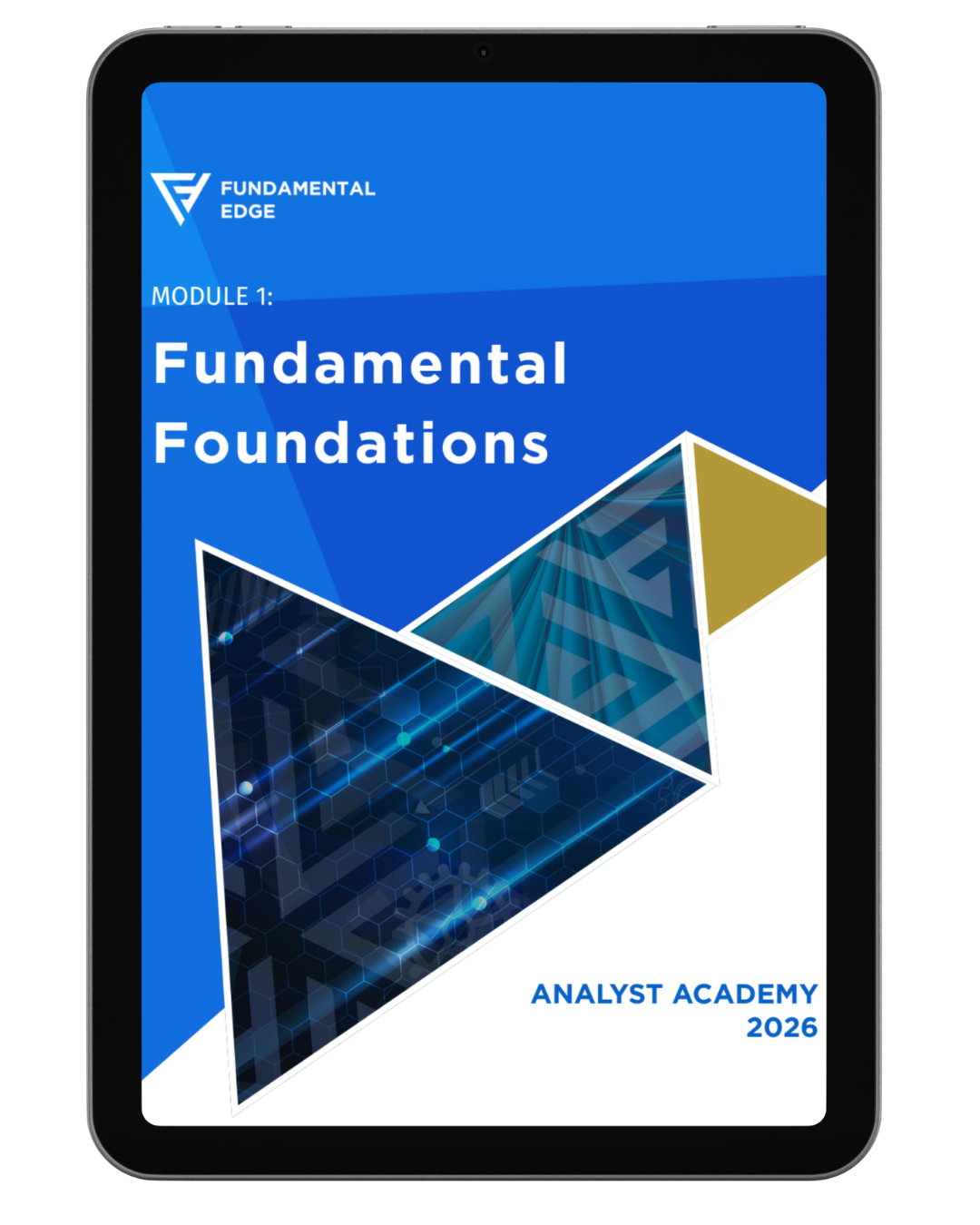
1) Fundamental Foundations
Fundamental analysis importance in market economies
Myth of efficient markets and reality
Four reasons why markets are not efficient
Alpha load and forms of mispricing
Recipe: skills, process, sound judgment
Idea generation and 10% mindset
Role of process and judgment in forming belief
Voting machine vs weighing machine
Goal: Identify mispricings, harvest alpha
Pareto distribution and top performer challenges
2) LIFE ON THE BUY-side
Buy-side primer: structure, roles, investment objectives
Limited partners (LPs) and their investment goals
Hedge funds: single-manager vs. multi-manager structures
Long-only funds: business model and challenges
Analyst role: idea generation to thesis development
Investment process: idea assessment to monitoring
Buy-side mindset
Leveraging information edge to generate alpha
Anatomy of a top-performing buy-side analyst
Creating a rigorous, repeatable investment process
3) Thesis Development
Thesis-driven investing: a structured approach
Analyst's role: developing expertise and ideas
Coverage models impact thesis development latency
Nine-step thesis development process
Model construction: key tool for analysis
Structured due diligence: FEV framework
Identifying key drivers and differentiated insights
Constructing the thesis: key elements, delivery
Presenting the thesis: succinct, focused, humble
Idea maintenance: monitoring key drivers, catalysts
4) Why Stocks Move Up and Down
Stocks move due to supply and demand
Market price: capital-weighted consensus of value
Drivers: fundamentals, expectations, valuation, non-fundamental factors
Stock price differs from business value
EPS growth, revisions, re-ratings
Focus Five framework: key business value drivers
Model linkage helps identify key drivers
Exceptionalism, perception shifts, narratives
Risk reduction and visibility impact valuations
Inflections and themes
-
5) IDEA Generation
Efficiency: avoiding deep dives prematurely
Seeking mispriced stocks likely to have alpha
Compounders, exceptionalism, and change/confusion
Thematic investing: themes drive revenue and value
Pattern recognition from experience guides idea generation
FEV framework: fundamentals, expectations, valuation
Cyclical vs secular trends often misunderstood
Idea screening using multiple lenses and criteria
Ingredients of compelling ideas: mispricing and catalysts
Efficient idea vetting process with PM check-ins
6) Buyside Modeling
The six reasons buy-side analysts build models
A step-by-step raw build: TSLA walk-through
Common modeling challenges
Bells & whistles: incr margin, 2-year stack & more
Understanding consensus & estimate revisions
Seven hacks for identifying variance vs. street
Mental frameworks for better forecasting
The three statements for stock pickers
What your PM is looking for in your model
The model & stock selection: NVST case
7) Analyze a Business
Read 10-K, earnings calls, sell-side research
Build simple model, identify key drivers
Assess business quality, viability, momentum
Analyze unit economics and cash economics
Understand market expectations priced in
Develop bull, base, bear cases
Focus research on 3 key drivers
Evaluate management and capital allocation
Compare to peers on key metrics
Analyze catalysts and risk/reward setup
8) Analyze an Industry
Learn industry through primers, experts, conferences
Develop universe tracker and comp sheets
Understand sector economics with industry P&L
Maintain coverage through regular blocking & tackling
Use model to identify inflections, catalysts
Connect dots between competitors and industry
Pursue both quick dives and deep dives
Long compounders with durable growth algorithms
Short melting ice cubes with structural headwinds
Pair trades can provide persistent alpha
9) Management & CapitaL Allocation
Why management matters (and when it doesn’t)
A framework to evaluate management
Doing a deep dive on a management team
The obsession with corporate access
A structured management meeting process
The role of investor relations
Navigating an investor conference
Analyzing stock-based compensation
Five options for deployment of cash
Analyzing stock buy-backs
10) Assessing Expectations
Stocks move based on expectations vs reality
Management guidance, sell-side estimates influence expectations
Price-implied expectations uncover market assumptions
Buy-side whisper reflects true market expectations
Assess positioning via ownership data, trading signals
Contrarian positioning can yield alpha but risks
Expectations gap: market view vs internal view
Differentiated, variant view key to generating alpha
Core debate, key drivers guide expectations work
Critical questions: situation overview, differentiation, monetization path
11) Applied Valuation
Stock valuation based on discounted cash flows
Key approaches: DCF, multiples, normalized earnings
Multiples are shorthand for a DCF
P/E roll-forward approach
Choosing an appropriate multiple
Earnings power approach
Develop risk/reward framework
Disaggregate stock returns
Create scenario trees with weighted outcomes
Be aware of terminal value perception
-
12) SHORT SELLING
Short selling basics and mechanics
Challenges and risks of shorting stocks
Shorting approaches: alpha, structural, event-driven, hedging
Identifying short ideas: fundamentals, expectations, valuation
Short alpha buckets and types of shorts
Importance of timing and risk management
Earnings season tactics for shorts
De-grossing: reducing exposure in tough markets
Quantitative short selection framework
Applying short selling mindset to long-investing
13) EARNINGS SEASON
Earnings season drives outsized stock volatility
Expectations gap and catalyst framework explained
Preparing for earnings: previews, positioning, catalysts
Updating models and assessing results efficiently
Evaluating surprise factor and algorithmic shifts
Estimating upside/downside moves and risk/reward
Tactics for earnings day and beyond
Analyzing read-throughs and adapting expectations bar
Identifying spring-loaded and peak-on-peak setups
Reacting to prints and fading overreactions
14) PITCH LIKE A PRO
Turn a promising idea into compelling thesis
Construct thesis using firm's preferred format
Key elements: summary, thesis points, risks, valuation
Tell a story with strong supporting data
Anticipate questions and prepare concise responses
Deliver pitch succinctly balancing confidence and humility
Follow up promptly on any open questions
Avoid thesis creep using a trading plan
Conduct pre-mortem and post-mortem using thesis document
When evaluating pitches, prepare to poke holes
15) WRAPPING UP
Rank stocks using reward/risk and qualitative scores
Idea stack: long and short book rankings
Three-year double: EPS growth and P/E expansion
Risk management: VaR, quant models, event frameworks
MIC: market view, internal view, convergence
FEV: fundamentals, expectations, valuation for idea generation
Achieving ETIK, focusing on key drivers (KDs)
Communicate idea with structured pitch script
Portfolio construction balancing risk/reward
across ideas
Analyst progression: junior to "full stack" partner
-
You'll get access to 6 months of live office hours sessions. Although these sessions are completely optional, they are a great resource for those who want to tap into the knowledge of our experienced instructor base.
Unable to make live sessions but still have questions? No worries! You can submit a question anytime in our mailbag and the instructors will answer if during the office hours session. We post the recordings to all the live sessions so you will be able to see what they said.
-
For students who want additional support and feedback, the Analyst Academy includes feedback on a final stock pitch capstone project. This is where you can apply what you learned to a real-world case study and hear what the instructors have to say about your idea.
Analyst Academy students also get one free 30 minute coaching session with Analyst Trainer Andrew Carr. Andrew has coached hundreds of students over the years, including multiple winners of the Perishing Square stock pitch competition.
What you’ll walk away with
Think like a buyside analyst
Spot opportunities and assess upside/downside the way real investors do, not the way textbooks describe it.
Build repeatable frameworks
Stop flailing. Analyze with structure and confidence using frameworks that have real currency with professional investors.
Accelerate your timeline
Compress years of chaotic osmotic learning into months. Contribute faster, earn trust faster, advance faster.
Ask better questions
A strong foundation means your PM conversations move to higher ground. Sharper questions, more productive dialogue, less second-guessing.
Monitor positions, not just pitch them
Learn how to track and manage stocks already in the portfolio, a skill most training programs ignore entirely.
Speak with authority
Discuss stocks and key value drivers with clarity in meetings, interviews, and PM conversations.
Who is this course for?
New buyside analysts
Analysts with 0-2 years learning the ropes and need help ramping.
High Potential Undergrads or MBAs
Looking to develop a skillset that will differentiate in interviews.
Experienced Buy-Side Analysts
Looking for a refresher, or analysts struggling to meet demands of the seat.
Sell-Side
Juniors
Looking for the buy-side approach to better serve their buy-side clients.
Investment Adjacent teams
Understand the work of the investment teams that you collaborate with.
High Potential Undergrads or MBAs
Looking to develop a skillset that will differentiate in interviews.
analysts across every major strategy trust analyst academy
Used by analysts across single-manager, multi-manager, long-only, family office, RIA, pension, and sovereign wealth funds.


Without a Structured
Process...
You waste years building frameworks that could have been built in months
Your development stays jagged and episodic
You're overlooked as expectations climb while your process doesn't
Credibility with your PM and team erodes
Your self-belief takes a hit
Compounding earnings are delayed by years
With Analyst Academy,
You...
Avoid learning costly mistakes the hard way
Advance your career instead of stagnating
Develop institutional frameworks that decision makers look for
Become a real investor instead of a hopeful observer
Build credibility that opens doors
Compress years of learning into months
FAQ’s
-
Compiling disparate sources takes time and produces an inconsistent, non-repeatable framework. Analyst Academy gives you an organized, proven version. Built once, used forever.
-
The core curriculum is 35h and fully self-paced. Live sessions and guest speakers are optional. Engage on your own schedule. You have full access to all materials for one year from enrollment.
-
All live sessions are recorded. You can also submit questions via our mailbag and receive answers async.
-
Yes. Many of our students are firm-sponsored. Your firm may have a training budget for exactly this type of expense. Analyst Academy also accepts soft dollars. Email info@fundamentaledge.com for details.
-
Payment plans are available and displayed at checkout.
Ready to stop spinning your wheels and start thriving on the buyside?
Join analysts across every major fund mandate who are building the frameworks that earn PM trust and accelerate careers.